



Return-to-Office vs. Work-from-Home: Top Companies’ Policies in 2025

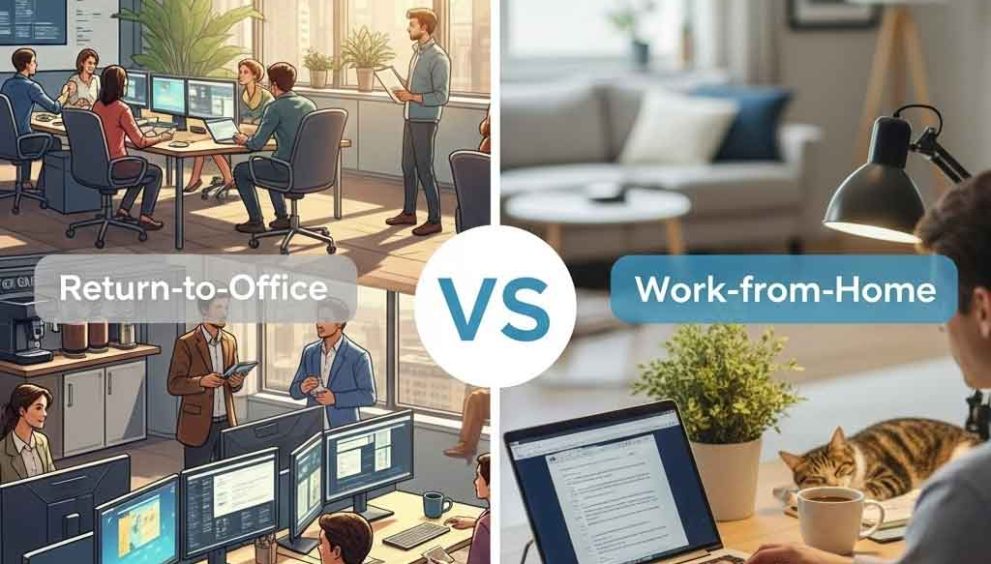
As 2025 unfolds, the workplace is at a crossroads. Companies across the U.S. and beyond are wrestling with whether to bring employees back to the office or embrace the flexibility of work-from-home (WFH) and hybrid models. With 70% of employers planning stricter return-to-office (RTO) policies this year, according to Forbes, the debate is heating up. Some argue in-person work sparks creativity and strengthens team bonds, while others champion remote work for its productivity and work-life balance benefits. For American professionals, job seekers, and global workers eyeing U.S. opportunities, understanding which companies are enforcing office returns versus those offering remote flexibility is key. This article, crafted for ClickUSANews.com, breaks down the latest trends, lists major players on both sides, and explores what these shifts mean for the future of work.
Why the Push for Return-to-Office?
The move to bring employees back to the office is driven by a mix of practical and cultural factors. Executives point to enhanced collaboration, stronger company culture, and the need to justify pricey office spaces as reasons for RTO mandates. Yet, employees are pushing back, citing long commutes, childcare challenges, and the proven efficiency of remote work. Let’s dive into the companies leading the charge for in-office work and those doubling down on flexibility, updated for August 2025.
Companies Mandating Return-to-Office in 2025
Several industry giants have rolled out strict RTO policies, requiring employees to return to the office full-time or for most of the week. Here’s a detailed rundown of key players enforcing in-office work and how employees are responding.
- Amazon
- RTO Policy: As of January 2025, Amazon requires all corporate employees to work in-office five days a week. CEO Andy Jassy says this move will boost teamwork and reinforce company culture.
- Employee Reaction: Over 30,000 workers joined a “remote advocacy” Slack channel, with 90% of surveyed employees opposing the mandate. Desk shortages in offices like New York and Atlanta have caused logistical hiccups.
- Why It Matters: Amazon’s bold policy sets a tone for tech, but resistance signals tension for workers valuing flexibility.
- AT&T
- RTO Policy: Starting January 2025, AT&T mandates full-time office work for all corporate staff, arguing it enhances customer service and aligns with pre-pandemic norms.
- Employee Reaction: A Change.org petition with over 7,800 signatures highlights concerns about commuting costs and work-life balance.
- Why It Matters: AT&T’s shift could influence telecom, impacting professionals seeking hybrid roles.
- Walmart
- RTO Policy: By January 2025, Walmart requires corporate employees to work full-time in offices, with many asked to relocate to Bentonville, Arkansas, or other hubs. Non-compliance risks termination.
- Employee Reaction: Frustration led to resignations, with relocation demands sparking heated discussions in company-wide meetings.
- Why It Matters: Walmart’s policy may deter talent unwilling to relocate, affecting U.S. workers eyeing retail careers.
- The Washington Post
- RTO Policy: Managers return full-time in February 2025, with all staff required in-office five days a week by June 2025.
- Employee Reaction: Staff are adjusting to the phased approach but express concerns about flexibility loss.
- Why It Matters: The media industry’s shift to in-person work could reshape newsroom dynamics.
- JPMorgan Chase
- RTO Policy: From March 2025, all employees must work in-office five days a week, with CEO Jamie Dimon emphasizing in-person learning.
- Employee Reaction: Hundreds raised commuting and childcare concerns during a town hall, with comments quickly disabled.
- Why It Matters: JPMorgan’s strict policy could set a precedent for finance, impacting U.S. professionals in banking.
- Dell
- RTO Policy: Starting March 3, 2025, employees near Dell offices must work in-person five days a week, reversing earlier hybrid flexibility.
- Employee Reaction: The sudden shift has sparked childcare and logistical complaints, though Dell is upgrading office spaces.
- Why It Matters: Dell’s move may influence tech firms, affecting workers seeking flexible roles.
- WPP
- RTO Policy: From April 2025, WPP mandates at least four in-office days a week, with one flexible WFH day.
- Employee Reaction: Over 2,000 employees signed a petition calling the policy regressive.
- Why It Matters: As a global ad leader, WPP’s stance could shape creative industries.
- Google
- RTO Policy: In 2025, Google enforces a hybrid model, requiring teams like Technical Services and HR to work in-office three days a week, with relocation support for some.
- Employee Reaction: The Alphabet Workers Union (1,400+ members) is pushing for a say in RTO decisions.
- Why It Matters: Google’s balanced approach may appeal to workers seeking hybrid options.
- Minnesota State Government
- RTO Policy: Starting June 2025, state employees must work in-office at least half the time, ending years of remote flexibility.
- Employee Reaction: Unions, like the Minnesota Association of Professional Employees, criticized the lack of input.
- Why It Matters: Public sector shifts could influence U.S. government job policies.
- Uber
- RTO Policy: In June 2025, Uber increased in-office requirements from two to three days a week.
- Employee Reaction: CEO Dara Khosrowshahi’s blunt “It is what it is” response during a meeting fueled discontent.
- Why It Matters: Uber’s gradual RTO push reflects caution but may frustrate workers.
- Disney
- RTO Policy: Disney mandates a four-day in-office week (Monday-Thursday), set by CEO Bob Iger in 2023.
- Employee Reaction: Limited pushback, as creative roles often thrive in-person.
- Why It Matters: Disney’s policy may attract U.S. media professionals but limit remote options.
- Goldman Sachs
- RTO Policy: Goldman Sachs enforces a five-day in-office policy, prioritizing an office-first culture.
- Employee Reaction: Early enforcement faced resistance, with leaders cracking down on attendance.
- Why It Matters: Finance’s office-centric trend could impact U.S. banking professionals.
- Boeing
- RTO Policy: Since January 2024, Boeing requires full-time office work, with full implementation pending 2026 union talks.
- Employee Reaction: Unions are delaying the policy, citing worker concerns.
- Why It Matters: Boeing’s stance may influence aerospace, affecting U.S. engineers.
- Starbucks
- RTO Policy: Corporate employees within commuting distance must work in-office three days a week.
- Employee Reaction: Criticism grew due to CEO Brian Niccol’s flexible commuting arrangement.
- Why It Matters: Starbucks’ hybrid model balances flexibility but may spark equity concerns.
- X (Twitter)
- RTO Policy: Since Elon Musk’s 2022 acquisition, X requires full-time office attendance, with non-compliance treated as resignation.
- Employee Reaction: Significant pushback, though incentives aim to motivate workers.
- Why It Matters: X’s hardline policy may deter tech talent seeking flexibility.
Companies Championing Work-from-Home and Hybrid Models
While RTO mandates dominate headlines, many companies are sticking with remote or hybrid work to attract talent and boost satisfaction. Here are the top players offering flexibility in 2025.
- Adobe
- Policy: Employees work in-office 2-3 days a week, with hybrid flexibility. Adobe plans to double its remote workforce.
- Why It Matters: A 58% surge in job applications makes Adobe a top choice for U.S. tech and creative professionals.
- Airbnb
- Policy: Employees can work remotely in 170 countries for up to 90 days a year, with no office mandate.
- Why It Matters: Airbnb’s policy, linked to a 40% revenue boost and low turnover, appeals to U.S. workers seeking mobility.
- Atlassian
- Policy: The “Team Anywhere” model allows work from any city or country where Atlassian operates, with minimal in-office requirements (four times a year).
- Why It Matters: Atlassian’s flexibility suits U.S. software developers prioritizing remote work.
- Coinbase
- Policy: Fully remote, with optional office access and quarterly in-person events.
- Why It Matters: Coinbase’s remote-first approach attracts U.S. fintech professionals.
- GitLab
- Policy: Fully remote, with 1,500+ employees across 65+ countries, offering home office equipment reimbursement.
- Why It Matters: GitLab’s model is ideal for U.S. tech workers in DevOps roles.
- HubSpot
- Policy: Employees choose in-office (three or two days a week) or fully remote, with a monthly home office stipend.
- Why It Matters: HubSpot’s flexibility appeals to U.S. marketing and CRM professionals.
- Shopify
- Policy: Fully remote, with no mandatory office days.
- Why It Matters: Shopify’s approach supports U.S. e-commerce workers seeking autonomy.
- Dropbox
- Policy: A “virtual-first” model offers full-time remote work with home office support.
- Why It Matters: Dropbox’s policy attracts U.S. tech talent focused on flexibility.
- Nvidia
- Policy: Employees choose remote, in-office, or hybrid work, with no mandatory RTO plans.
- Why It Matters: Nvidia’s flexibility draws U.S. AI and tech professionals.
- Slack
- Policy: A hybrid model lets employees choose remote or in-office collaboration days.
- Why It Matters: Slack’s approach suits U.S. communication and tech workers.
RTO vs. WFH: What’s Driving the Divide?
Why Companies Want Office Returns
- Collaboration: Leaders cite in-person work for sparking innovation, with MIT’s 2022 study showing reduced patent citations without face-to-face meetings.
- Culture: Physical presence is seen as key to team cohesion, though Gallup suggests management quality matters more.
- Real Estate: CBRE reports rising office vacancies, pushing companies to utilize leased spaces.
- Oversight: In-person work simplifies monitoring, but risks micromanagement.
Why Remote Work Thrives
- Productivity: A Turkish study showed 10% more calls handled remotely, and a Chinese firm saw 33% lower turnover with hybrid work.
- Talent Attraction: Autodesk’s 58% application increase and 82% rise in female candidates highlight flexibility’s appeal.
- Satisfaction: Remote workers report higher engagement, though stress and isolation are challenges.
- Cost Savings: Remote work cuts commuting and relocation costs, benefiting U.S. workers.
What This Means for U.S. Professionals
For American workers, the RTO vs. WFH debate shapes career decisions:
- Job Choices: Remote-friendly companies like Airbnb and GitLab offer flexibility, while RTO firms like Amazon may limit options to office hubs.
- Work-Life Balance: Remote work saves commuting time, crucial for professionals juggling family or side hustles.
- Relocation: Policies like Walmart’s relocation mandate may deter workers unable to move.
- Career Growth: Flexible firms attract diverse talent, giving U.S. job seekers more options.
The Future of Work: Hybrid as the Norm?
Hybrid models are likely to dominate, with Stanford and Federal Reserve data showing most companies sticking with flexible policies in 2025. Smaller firms use remote work to compete with giants, as University of Pittsburgh’s Mark Ma notes. However, a cooling job market may empower employers to enforce stricter RTO rules. LinkedIn’s Kory Kantenga predicts that an aging workforce will eventually push companies to offer more flexibility to attract talent.
Conclusion: Navigating the 2025 Workplace
The clash between RTO and WFH reflects a broader quest to balance productivity, culture, and employee needs. Companies like Amazon and JPMorgan are betting on in-office work, while Adobe and Airbnb prioritize flexibility to attract top talent. For U.S. professionals, choosing the right employer means aligning with your work style—whether it’s the energy of an office or the freedom of remote work.
Stay updated with ClickUSANews.com for the latest workplace trends and career insights!