
Trump Relocates Obama and Bush Portraits to Hidden White House Stairwell

A Break from Tradition
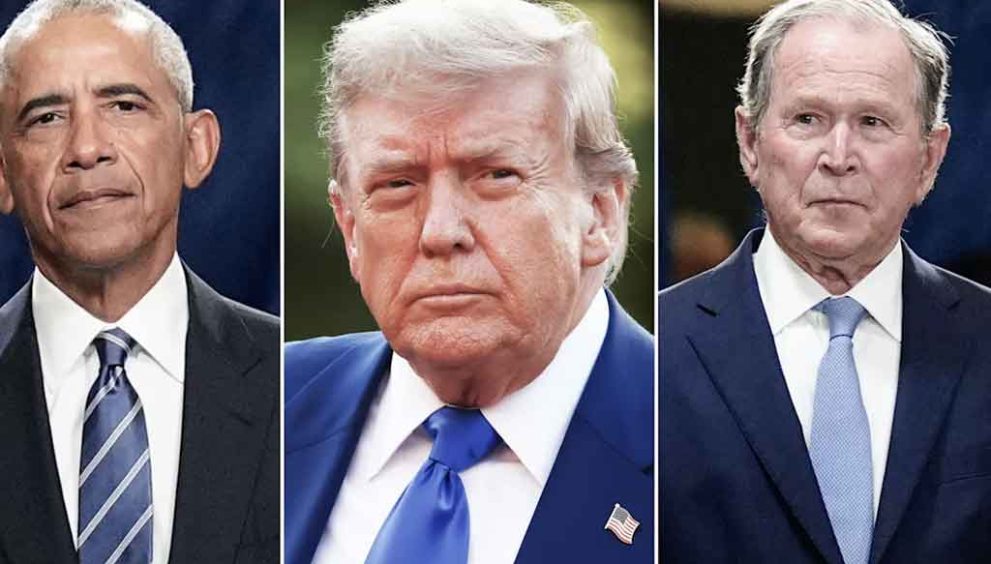
On August 10, 2025, reports emerged that President Donald Trump ordered the relocation of the official White House portraits of former Presidents Barack Obama, George W. Bush, and George H.W. Bush to a secluded stairwell, breaking with long-standing White House tradition. Typically, portraits of recent presidents are displayed prominently in areas like the Grand Foyer, where they are visible to guests, foreign dignitaries, and public tour groups. This move has sparked discussions about symbolism, respect, and the ongoing tensions between Trump and his predecessors.
The Details of the Relocation
According to sources familiar with the matter, Trump directed White House staff to move Obama’s portrait to the top of the Grand Staircase, a restricted area primarily accessible to the presidential family, Secret Service agents, and select staff. The portraits of George W. Bush and his father, George H.W. Bush, were also relocated to the same stairwell, effectively removing them from public view. This marks a significant departure from protocol, which emphasizes showcasing recent presidents’ portraits in high-traffic areas to honor their legacies.
This is not the first instance of Obama’s portrait being repositioned during Trump’s tenure. In April 2025, the portrait was moved across the Grand Foyer and replaced with a painting depicting Trump raising his fist after surviving an assassination attempt in Butler, Pennsylvania. The latest relocation to the Grand Staircase further obscures the visibility of Obama’s portrait, as well as those of the Bushes, from the thousands of visitors who tour the White House annually.
Context of Tensions
The decision to relocate these portraits comes amid well-documented tensions between Trump and the former presidents. Trump’s relationship with Obama has been particularly contentious, marked by public disputes dating back to Trump’s promotion of the “birther” conspiracy theory questioning Obama’s citizenship. In recent months, tensions have escalated further, with Trump accusing Obama and his administration of “treason” related to alleged misconduct during the 2016 election. Obama’s office has dismissed these claims as “outrageous” and “a weak attempt at distraction,” particularly in light of scrutiny surrounding Trump’s administration and the Jeffrey Epstein investigation.
Similarly, Trump’s relationship with the Bush family has been strained. The late George H.W. Bush reportedly called Trump a “blowhard” and voted for Hillary Clinton in the 2016 election. George W. Bush, who attended Trump’s 2025 inauguration but skipped the subsequent luncheon, has been labeled by Trump as a “failed and uninspiring” president. These personal and political frictions provide context for the decision to move the portraits, which many interpret as a symbolic gesture to diminish the visibility of these leaders’ legacies.
Symbolic and Cultural Implications
The relocation of Obama’s portrait, in particular, carries significant weight for many Americans, especially within the African-American community. As the first Black president, Obama’s portrait in a prominent White House location symbolized progress and representation. Its removal to a restricted area, alongside those of the Bushes, has been criticized as an attempt to reshape the narrative of American leadership. Critics argue that the move undermines the tradition of honoring bipartisan respect and continuity, which has been a hallmark of White House decor since the 1960s, when First Lady Jacqueline Kennedy formalized the presidential portrait tradition.
The White House Historical Association, which privately funds these portraits, has historically facilitated unveiling ceremonies as gestures of goodwill between administrations. The current relocation, however, contrasts with this spirit of unity, prompting questions about whose legacies are prioritized in the nation’s most iconic residence.
Broader White House Aesthetic Changes
Trump’s involvement in White House aesthetics extends beyond the portrait relocations. Sources indicate that he is deeply engaged in decor decisions, from minor adjustments to significant renovations. Since returning to the presidency, Trump has overseen changes such as paving over the historic Rose Garden’s lawn with concrete, adding gold leaf accents to the Oval Office, and removing a bust of Martin Luther King Jr. and a 50-year-old pot of Swedish ivy from the Oval Office. Plans for a $200 million ballroom styled after Trump’s Mar-a-Lago resort have also been reported, reflecting his preference for opulent design.
In another notable instance, Trump demanded the removal of his own portrait from the Colorado State Capitol in March 2025, criticizing it as “deliberately distorted” and “perhaps the worst painting” of himself. The portrait, created by artist Sarah A. Boardman (who also painted Obama’s portrait for the same venue), was subsequently taken down following Trump’s public outcry on Truth Social.
Public and Political Reactions
The portrait relocations have elicited varied responses. Some critics, as seen in posts on X, have described the move as a “vindictive banishment” reflecting Trump’s “petty insecurity” and a disregard for bipartisan respect. Others have defended the decision, arguing that the placement of portraits is within the president’s purview and dismissing the controversy as overblown.
The White House has not issued an official statement on the relocations, and a spokesperson for Obama’s office declined to comment. The offices of George W. Bush and the George H.W. Bush Presidential Library and Museum have also been contacted for comment, but no responses have been reported.
Looking Ahead
As the White House continues to serve as a stage for American history, the relocation of these portraits raises broader questions about representation, legacy, and the power of symbols. For many, the move underscores the need to preserve an inclusive narrative of leadership that honors the contributions of all presidents, regardless of political differences. As history unfolds, the placement of these portraits will likely remain a point of discussion, reflecting the evolving dynamics of American politics.
Sources: CNN, Yahoo, The Independent, ABC45, CubaHeadlines, India Today, Internewscast, Posts on X