


EV Sales Rebound: What 2026 US Demand Data Reveals

EV Sales Rebound: What Last Week’s Data Says About 2026 Demand in the US
The US electric vehicle (EV) market experienced significant turbulence in late 2025, particularly after the federal clean vehicle tax credit expired in September 2025 under new policy changes. Q3 2025 saw a record surge (market share hitting 10.5%) as buyers rushed to claim the $7,500 incentive, followed by a sharp Q4 drop (share falling to around 5.8%). However, last week’s data releases (mid-to-late January 2026) from sources like Cox Automotive, Kelley Blue Book, and industry analysts highlight early signs of stabilization and rebound momentum heading into 2026.
December 2025 new EV sales reached an estimated 84,294 units—up 14.4% month-over-month from November—despite being down year-over-year due to the incentive cliff. This rebound in the final month of 2025 signals consumer resilience and sets a positive tone for EV sales 2026 and electric vehicle demand. Full-year 2025 EV sales totaled nearly 1.3 million units (second-best on record, down only ~2% from 2024), with EV share at 7.8% of the total new-vehicle market.
Analysts from Cox Automotive and others project EV market recovery in 2026, with share stabilizing near 8% (potentially flat or modestly up from 2025’s annual average). This stabilization stems from aggressive price cuts, manufacturer incentives, expanding charging infrastructure, and a wave of new affordable models. While short-term headwinds like policy shifts and higher effective prices persist, structural improvements point to gradual growth rather than decline.
Key Drivers Behind the EV Sales Rebound and 2026 Outlook
- Manufacturer Price Cuts and Record Incentives Automakers responded swiftly to the loss of federal credits by slashing prices and offering heavy discounts. In December 2025, average incentives hit record levels (~$10,473 per vehicle or 17–18% of transaction price in recent months). This brought effective prices for popular models below $40,000 in many cases.
- Tesla Model Y and Model 3 saw pricing adjustments.
- Chevrolet Equinox EV launched with competitive positioning (low ATP around $38,000).
- Brands like Hyundai, Ford, and GM ramped up rebates. These moves narrowed the price gap with gas vehicles, making EVs more accessible and driving the December uptick. For 2026, continued discounting—combined with falling battery costs—is expected to sustain demand.
- Proliferation of New Affordable and Compelling Models 2026 brings a refreshed lineup that addresses past barriers like range anxiety and cost. Key launches include:
- Affordable refreshed Chevrolet Bolt.
- Rivian R2 (mid-size SUV targeting mainstream buyers).
- New-generation BMW EVs (e.g., iX3 SUV).
- Potential entries like Nissan LEAF updates and Toyota options. These models expand choices across price points, with many under $50,000 before incentives. Analysts note that product innovation will fuel gradual adoption, especially as early-adopter saturation gives way to mainstream buyers.
- Charging Infrastructure Growth and Reliability Improvements Despite policy uncertainty (e.g., pauses in some federal NEVI funding), private-sector expansion continues. Tesla’s Supercharger network opened to more non-Tesla brands in 2025–2026, boosting accessibility. Overall public and home charging points are increasing, with better reliability reducing range concerns. Cox Automotive highlights “improving charging reliability” as a core factor in 2026 momentum. As infrastructure matures, consumer confidence grows—critical for electric vehicle demand beyond early adopters.
- Used EV Market Strength Used EV sales rose in December (28,579 units, up 9.7% MoM and 10.2% YoY), capturing 1.9–2.1% of the used market. Affordable used options (often under $30,000) provide entry points, with high owner satisfaction driving resale value and broader adoption.
American-Wide Perspective: National Trends and Projections
Nationally, EV sales 2026 are forecasted to be “mostly flat” or modestly higher than 2025’s ~1.3 million units, per Cox Automotive and Kelley Blue Book. Share is expected near 8%, supported by:
- Market maturation beyond incentive dependency.
- Productivity in battery tech and supply chains.
- Consumer focus shifting to total ownership costs (lower fuel/maintenance).
While January 2026 projections show EV share dipping to ~6.6% (due to seasonal factors and post-credit adjustment), experts view this as temporary. Long-term forecasts remain optimistic: gradual climb toward higher penetration by 2030, driven by the factors above.
State-Wise Breakdown: Where Demand is Strongest
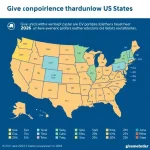
EV adoption varies significantly by state, influenced by local incentives, charging availability, urban density, and policy support (even as federal credits ended). Latest available registration and sales data (through late 2025) show:
- California — Remains the leader with over 1.25 million registered light-duty EVs (as of 2023 data, with continued high share). However, 2025 saw a slight dip in new sales (first post-pandemic decline in early periods), nearing saturation among early adopters. Still accounts for ~35% of national EVs.
- Florida — Rapid growth: +33% in sales through September 2025 (~109,000 units, 9% market share). Warm climate, population influx, and expanding charging support rebound momentum.
- Texas — Strong rise (+16.7% to ~77,000 units in first 9 months of 2025). Infrastructure investments and urban centers drive demand.
- Other High-Growth States — Illinois (+36.2% to 32,000), Georgia (+23.3% to 28,000), Michigan (+90.7% to 31,000). These non-traditional leaders show broadening appeal beyond coastal states.
- Emerging Leaders — Washington, Colorado, and New York maintain high per-capita adoption due to local rebates and green policies.
State-level variations highlight that EV market recovery is uneven—stronger in Sun Belt and Midwest growth areas—while California stabilizes. Local incentives (where still available) and charging density will influence 2026 trajectories.
Challenges and Realistic Path Forward for 2026
Short-term hurdles include:
- Higher transaction prices post-credits.
- Inventory buildup (130 days’ supply for new EVs in early 2026).
- Policy uncertainty around tariffs and infrastructure funding.
Yet, the rebound in December sales, high incentives, and new models counter these. Analysts emphasize that the US EV transition is “delayed but not derailed”—structural factors like improving economics and infrastructure ensure progress.
Conclusion: Optimism for EV Sales 2026
Last week’s data—from December’s month-over-month rebound to analyst projections—paints a picture of EV market recovery rather than retreat. Price cuts, sustained incentives, charging growth, and fresh models are stabilizing electric vehicle demand and positioning 2026 for steady gains.
For buyers, now is an opportune time with deals abundant. The US EV story shifts from incentive-driven spikes to sustainable, market-led growth. Track EV sales 2026 developments on clickusanews.com for the latest insights.
For more USA news check:
https://clickusanews.com/news/
Latest USA breaking news, national headlines, global affairs, and trending stories.
https://clickusanews.com/sports/
USA sports news, live scores, match highlights, athlete updates, and major sporting events.
https://clickusanews.com/technology/
Technology news covering AI, gadgets, innovation, cybersecurity, and digital trends in the USA.
https://clickusanews.com/entertainment-movies-ott/
Entertainment updates including movies, OTT releases, celebrity news, and pop culture stories.
https://clickusanews.com/business/
Business and finance news with USA market updates, corporate stories, crypto, and economic insights.