



Hurricane Erin Path Tracker: Category 4 Storm’s Path and Impacts for 2025

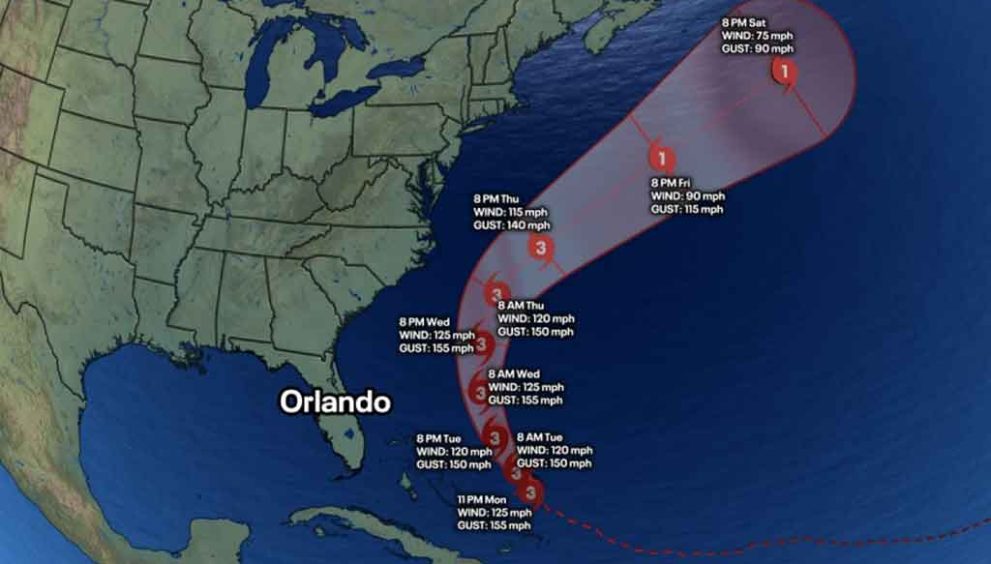
August 18, 2025 – Hurricane Erin, the first hurricane of the 2025 Atlantic hurricane season, has escalated into a powerful Category 4 storm, prompting widespread concern across the southeastern United States, the Caribbean, Bermuda, and Atlantic Canada. With maximum sustained winds of 130 mph and a sprawling wind field, Erin is generating life-threatening surf, rip currents, and potential coastal flooding. This comprehensive story for ClickUSANews.com details Erin’s current status, projected path, potential impacts, and essential preparedness tips, drawing on the latest updates from the National Hurricane Center (NHC) and other meteorological sources.
Current Status and Location
As of 5 a.m. ET on August 18, 2025, Hurricane Erin is centered approximately 915 miles south-southeast of Cape Hatteras, North Carolina, and 105 miles north-northeast of Grand Turk Island. Moving northwest at 13 mph with a central pressure of 945 mb, Erin is a large and formidable storm. Its hurricane-force winds extend 80 miles from the center, while tropical-storm-force winds reach up to 230 miles, amplifying its impact across a wide region. After briefly reaching Category 5 status on August 16 with winds of 160 mph, Erin weakened to Category 3 during an eyewall replacement cycle but reintensified to Category 4 by Sunday night, August 17, according to the NHC.
Forecasted Path and Movement
The NHC forecasts that Erin will maintain its northwest trajectory through Monday, August 18, passing east of the southeastern Bahamas. A gradual turn to the north is expected by Tuesday, August 19, positioning the storm’s core between Bermuda and the U.S. East Coast by midweek. While Erin is not projected to make direct landfall in the continental United States, its expansive size ensures that its effects will be felt across a broad area. By Wednesday, August 20, Erin is expected to approach the Outer Banks of North Carolina and Bermuda, potentially bringing tropical storm or hurricane conditions to the latter.
Spaghetti models, which aggregate various forecast tracks, indicate Erin will remain well offshore from Florida and the southeastern U.S. coast, with the storm’s center likely staying hundreds of miles east of the mainland. However, the NHC cautions that the forecast cone represents only the probable path of the storm’s center and does not account for its full width or impacts, with a 33% chance of the center deviating outside the cone. A cold front moving off the U.S. East Coast is expected to steer Erin further out to sea, reducing the likelihood of direct landfall but not eliminating its broader impacts.
Impacts and Hazards
United States East Coast
Despite remaining offshore, Erin’s massive size is generating significant ocean swells, leading to life-threatening surf and rip currents along the U.S. East Coast from Florida to New England. The NHC predicts waves of 6 feet on Monday, escalating to 8–12 feet by Wednesday, August 20, in areas like northern Florida, Myrtle Beach, South Carolina, and the Outer Banks. By Thursday, August 21, waves could reach 15–20 feet in Cape Hatteras, with impacts extending to New Jersey and Long Island through the weekend. These conditions pose severe risks to beachgoers, with 44 U.S. deaths attributed to rip currents in 2025 alone, according to the National Weather Service.
In North Carolina, Dare County has declared a state of emergency and issued a mandatory evacuation for Hatteras Island, effective August 17, due to anticipated coastal flooding and ocean overwash from Tuesday through Thursday. Portions of N.C. Highway 12 may become impassable, and beach erosion is a significant concern. The NWS in Morehead City warns that even under sunny skies, the rip current risk will remain high, urging beachgoers to avoid the water.
Caribbean and Bahamas
Erin’s outer rainbands have already caused significant impacts in the Caribbean. In Puerto Rico, heavy rainfall of 1–2 inches, with locally higher amounts, has triggered flash flooding and power outages affecting over 100,000 customers as of Sunday, August 17. Tropical storm warnings are in effect for the Turks and Caicos Islands and the southeastern Bahamas, with tropical storm conditions expected through Monday. The NHC forecasts 2–4 inches of rain, with isolated totals up to 6 inches, potentially causing flash flooding, landslides, and mudslides in these areas. A tropical storm watch is also in place for the central Bahamas.
Bermuda
As Erin turns north, Bermuda is expected to experience impacts by midweek, including very rough seas and potential tropical storm or hurricane-force winds. The NHC advises residents to monitor the storm closely and prepare for hazardous conditions, including high surf and heavy rainfall, by Wednesday, August 20.
Rapid Intensification and Historical Context
Hurricane Erin’s rapid intensification from a tropical storm to a Category 5 hurricane in just 24 hours on August 15–16 marks it as one of the most explosive Atlantic storms on record. Peaking with 160 mph winds, Erin joined an elite group of early-season Category 5 hurricanes, including Allen (1980), Charley (2004), Dennis (2005), Emily (2005), and Beryl (2024). This rapid strengthening, fueled by exceptionally warm ocean waters (above 80°F) and favorable atmospheric conditions, underscores the growing influence of climate change on hurricane intensity. After undergoing an eyewall replacement cycle, Erin weakened to Category 3 but regained Category 4 strength by Sunday night, with further fluctuations possible.
The storm’s large size following the eyewall replacement has broadened its wind field, increasing the reach of dangerous surf and rip currents. This phenomenon, combined with Erin’s early-season intensity, highlights the challenges of forecasting and preparing for rapidly evolving storms in a warming climate.
Preparedness and Safety Recommendations
The NHC, NOAA, and local authorities urge residents in potentially affected areas to take the following steps:
- Evacuation Planning: Develop and share an evacuation plan, identifying safe routes and destinations. Follow local evacuation orders, such as those in Dare County, North Carolina.
- Emergency Supplies: Assemble a kit with food, water, medications, batteries, and first-aid supplies for at least 72 hours, or longer if anticipating extended disruptions.
- Property Protection: Secure homes by installing storm shutters, reinforcing windows, and clearing loose objects. Trim trees to reduce the risk of falling branches.
- Insurance Review: Verify homeowner’s and flood insurance coverage, noting that flood insurance requires a 30-day waiting period and is not covered by standard policies.
- Stay Informed: Monitor updates from the NHC (www.nhc.noaa.gov), local weather services, or trusted sources like ClickUSANews.com. Sign up for weather alerts to stay ahead of changing conditions.
- Avoid the Water: Refrain from swimming or surfing due to life-threatening rip currents, especially along the U.S. East Coast from Tuesday through Thursday.
Additional Tropical Activity
The NHC is also monitoring a tropical wave in the eastern Atlantic with a 50% chance of developing into a tropical depression within seven days. This system, moving westward, could approach the Leeward Islands, adding to the region’s tropical concerns. With August marking the start of the peak hurricane season (mid-August to mid-October), forecasters predict above-average activity for 2025, driven by warm sea surface temperatures.
Conclusion
Hurricane Erin, a sprawling Category 4 storm, poses significant threats to the Atlantic region despite its offshore trajectory. From life-threatening rip currents and high surf along the U.S. East Coast to heavy rainfall and flooding in the Caribbean and potential impacts in Bermuda, Erin demands vigilance and preparation. As the first hurricane of the 2025 Atlantic season, it serves as a stark reminder of the power and unpredictability of tropical systems. ClickUSANews.com encourages readers to stay informed, follow official guidance, and take proactive steps to ensure safety. For real-time updates, visit the National Hurricane Center or follow trusted sources like The Weather Channel.
Cheryl McCloud contributed to this report for ClickUSANews.com.