



US Launches Cruise Missile Strikes on Iran from Syria

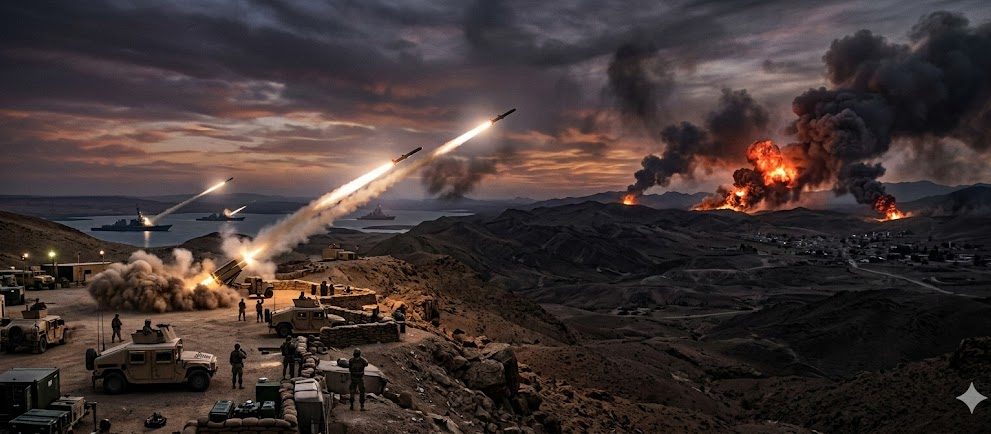
Breaking: US Launches Cruise Missile Strikes on Iran from Syrian Bases in Coordinated Operation with Israel
By American News Desk Published: February 28, 2026 | 1:30 PM EST ClickUSA News – Washington, D.C.
In a major escalation of the ongoing 2026 Iran–United States crisis, the United States has fired cruise missiles from military positions in Syria targeting key sites inside Iran. The strikes, conducted in coordination with Israel, mark a direct U.S. military action against Iranian territory and come amid weeks of intense buildup and failed diplomacy over Iran’s nuclear and missile programs.
U.S. Forces Strike Iranian Targets
Multiple reports confirm that U.S. forces launched cruise missiles—likely Tomahawk land-attack variants—from bases in Syria, with trajectories crossing Iraqi airspace toward targets in Iran. Eyewitness videos circulating on social media show missiles in flight over regions like Saladin Governorate in Iraq, heading toward Iranian cities including Tehran, Isfahan, Qom, and Khorramabad.
The operation, described by U.S. officials as part of a broader campaign, follows Israel’s initial preemptive strikes and involves joint U.S.-Israeli efforts. A U.S. official confirmed to media outlets that American air and sea assets are actively engaged, with strikes expected to continue over several days. Targets appear focused on degrading Iran’s military infrastructure, including Islamic Revolutionary Guard Corps (IRGC) facilities, missile production sites, air defenses, and elements tied to its nuclear and ballistic missile programs.
This action builds on the U.S. military’s massive regional posture, including two carrier strike groups (USS Gerald R. Ford and USS Abraham Lincoln), advanced fighter jets, and air defense systems deployed across the Middle East—the largest such buildup since the 2003 Iraq invasion.
Background: From Diplomacy to Direct Action
Tensions have simmered since the 2025 Twelve-Day War between Israel and Iran, where U.S. forces joined Israel in striking three major Iranian nuclear sites (Fordow, Natanz, and Isfahan), setting back Iran’s program by months. Iran retaliated with missile attacks on U.S. bases but agreed to a fragile ceasefire.
Recent negotiations stalled over U.S. demands for Iran to halt uranium enrichment, dismantle long-range ballistic missiles, end support for proxy groups like Hezbollah and the Houthis, and address domestic repression. President Donald Trump, in his State of the Union address and public statements, warned Iran against rebuilding its nuclear and missile capabilities, stating that missiles capable of reaching the United States were in development.
Iran’s regime has faced massive internal protests since 2025, with tens of thousands killed and widespread detentions. Tehran has accelerated arms acquisitions, including Verba MANPADS from Russia and potential anti-ship cruise missiles from China, while conducting military exercises near the Strait of Hormuz.
Iranian Response and Risks Ahead
Iranian officials have denounced the strikes as “aggression” and vowed a “crushing” retaliation. IRGC forces have mobilized, with remaining ballistic missiles repositioned in hardened sites. Proxies in Iraq, Lebanon, and Yemen have threatened attacks on U.S. bases and shipping.
The strikes raise the specter of broader conflict, including potential disruptions to the Strait of Hormuz—through which 20% of global oil flows—driving oil prices sharply higher. U.S. allies in the Gulf, including Saudi Arabia and the UAE, have expressed concerns over Iranian missile threats to regional infrastructure.
U.S. Perspective and Global Reactions
President Trump has framed the action as necessary to prevent Iran from acquiring nuclear weapons and threatening American interests. U.S. officials emphasize that the strikes aim to protect U.S. troops and allies while avoiding full-scale war.
- Congress: Bipartisan calls for briefings as lawmakers monitor developments.
- United Nations: Secretary-General António Guterres urged immediate de-escalation.
- Markets: Brent crude surged over 15%, topping $120 per barrel in early trading.
ClickUSA News will provide ongoing updates as this fast-moving situation develops. Americans abroad, particularly in the Middle East, should follow U.S. State Department advisories and exercise caution.