


FBI Report: $20.8B Lost to Scams in 2025

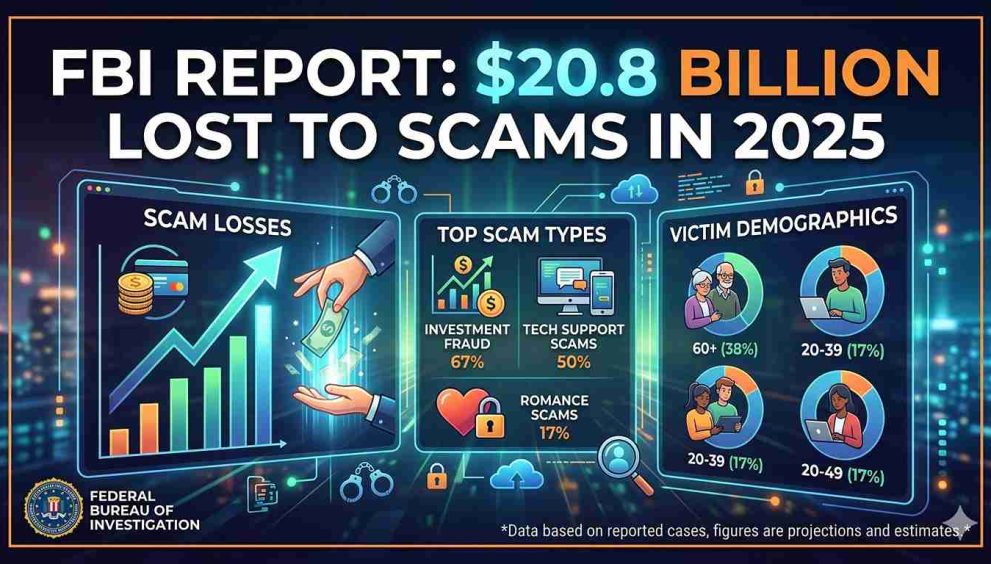
The FBI’s Internet Crime Complaint Center (IC3) has released its 2025 Internet Crime Report, revealing a sobering new record: Americans lost $20.877 billion to internet-enabled crimes in 2025 — a 26% increase from the previous year. For the first time, total complaints crossed the 1 million mark, with an average loss of $20,699 per complaint.
Cyber-enabled fraud accounted for about 85% of all reported losses, highlighting how sophisticated scams continue to target everyday Americans, seniors, and businesses alike.
This detailed report, marking the IC3’s 25th anniversary, underscores the growing threat of cryptocurrency scams, AI-powered fraud, investment schemes, and business email compromises under the current administration’s focus on protecting American families and the economy.
Key Highlights from the FBI 2025 Internet Crime Report
- Total Complaints: 1,008,597 (first time exceeding 1 million)
- Total Reported Losses: $20.877 billion (up 26% from 2024)
- Cyber-Enabled Fraud Complaints: Approximately 453,000, with losses exceeding $17.7 billion
- Average Loss per Complaint: $20,699
Investment fraud remained the biggest culprit, followed by business email compromise (BEC) and tech support scams. Seniors (age 60+) suffered the most, reporting $7.7 billion in losses — a 37% jump from the prior year.
Top Scams and Losses in 2025
Here’s a breakdown of the major crime types by reported losses:
- Investment Fraud: $8.648 billion (largest category, nearly 49% of scam-related losses)
- Business Email Compromise (BEC): $3.046 billion
- Tech/Customer Support Scams: $2.134 billion
- Personal Data Breach: $1.314 billion
- Confidence/Romance Scams: $929 million
- Government Impersonation: $797 million
Cryptocurrency Descriptor: A staggering $11.366 billion in losses across 181,565 complaints. Crypto investment scams alone accounted for over $7.2 billion. The average loss in crypto-related cases was around $62,000, with thousands losing over $100,000.
AI-Related Scams (new dedicated section in the report): 22,364 complaints resulting in $893 million in losses. Criminals used AI for voice cloning, deepfake videos, synthetic images, and convincing phishing emails — making scams harder to detect than ever.
Other notable categories included non-payment/non-delivery ($503 million), employment fraud ($362 million), and real estate scams ($275 million).
Who Was Hit the Hardest? Age Group Breakdown
The report shows clear vulnerability patterns by age:
- 60+ (Seniors): 201,266 complaints, $7.7 billion in losses (highest dollar amount)
- 50–59: 124,820 complaints, $3.7 billion
- 40–49: 167,066 complaints, $2.957 billion
- 30–39: 153,293 complaints, $1.7 billion
- 20–29: 112,069 complaints, $563 million
- Under 20: 31,254 complaints, $67 million
Seniors accounted for a disproportionate share of tech support and government impersonation losses. The FBI notes that older Americans remain prime targets due to trust, limited tech familiarity, and larger retirement savings.
State-Level Impact and Hotspots
While the full state-by-state breakdown is detailed in the report, high-loss states like Florida (often leading with over $1.6 billion in past years) and others with large retiree populations continued to suffer heavily. Cybercriminals targeted Americans nationwide, with no region immune.
Why Losses Keep Rising: Sophisticated Tactics
Criminals are evolving rapidly:
- Crypto scams often start with fake investment opportunities promising high returns, then disappear with funds transferred to untraceable wallets.
- AI tools enable realistic voice cloning (“grandparent emergencies”), deepfake videos of celebrities or officials, and personalized phishing at scale.
- BEC scams tricked businesses into wiring millions to fake accounts.
- Tech support scams impersonated companies like Microsoft or Apple, locking victims’ computers until payment.
The report also noted a rise in ransomware complaints (3,611 reports), though direct ransom losses were lower at around $32 million.
What the Trump Administration and FBI Are Doing
The FBI continues to emphasize public awareness and rapid reporting via IC3.gov. President Trump’s “America First” approach has included stronger focus on combating foreign-linked cyber threats, including state actors using crypto for illicit finance.
Law enforcement urges Americans to:
- Verify all unsolicited investment or tech support contacts.
- Use two-factor authentication and avoid clicking suspicious links.
- Report incidents immediately at IC3.gov — even small reports help track patterns.
- Never send money via wire transfer, gift cards, or crypto to unknown parties.
- Be especially cautious with AI-generated content that sounds or looks too real.
Protecting American Families in 2026
As scams grow more sophisticated with AI and crypto, every American — from retirees to young professionals — must stay vigilant. The $20.877 billion lost in 2025 could have funded schools, infrastructure, or family savings instead of lining criminals’ pockets, many of whom operate from overseas.
Click USA News encourages readers to review the full FBI 2025 IC3 Report and share this information with family and friends. Awareness remains the best defense.