



China Uses Humanoid Robots for Border Security in $37M

China Uses Humanoid Robots for Border Security in $37M
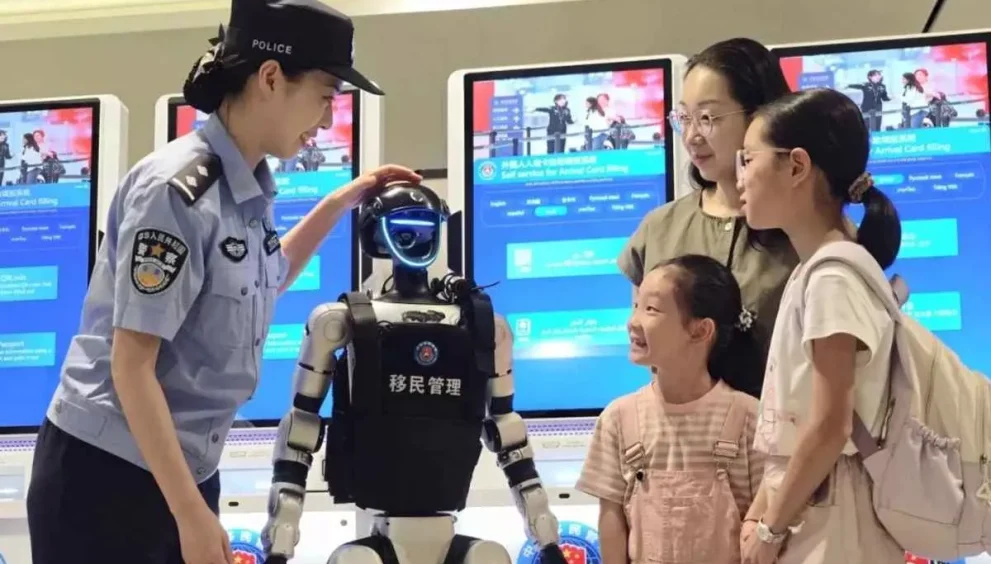
In a move straight out of science fiction, China has signed a groundbreaking 264 million yuan (approximately $37 million) contract with robotics giant UBTech to deploy cutting-edge Walker S2 humanoid robots at border crossings in Fangchenggang, a key coastal city in Guangxi province sharing a direct border with Vietnam. These sophisticated machines are set to handle traveler guidance, personnel management, inspections, patrols, logistics, and more — all while operating 24/7 in harsh, remote conditions thanks to their revolutionary autonomous battery-swapping capability.
Announced in late November 2025, the deal marks one of the world’s first large-scale deployments of humanoid robots in government and border security operations. Deliveries began in December, signaling China’s aggressive push to integrate embodied AI into real-world public services. As tensions over technology and automation rise globally, this pilot project could redefine how nations manage borders, blending innovation with efficiency.
The Deal: $37 Million for Robotic Border Guardians
UBTech Robotics, a Shenzhen-based leader in humanoid technology, secured the contract with a specialized humanoid robot center in Fangchenggang. The project focuses on the Walker S2, an industrial-grade humanoid launched in July 2025 and hailed as the world’s first robot capable of independently swapping its own battery.
Key details of the deployment:
- Location: Border checkpoints in Fangchenggang, Guangxi — a bustling trade gateway with Vietnam exposed to humid, tropical weather and high traffic.
- Tasks: Guiding travelers, managing queues and personnel flow, assisting with patrols, conducting inspections, handling logistics, and providing commercial support services.
- Timeline: Initial deliveries and operations started in December 2025 as a pilot program.
- Broader Scope: Robots will also support inspections in nearby manufacturing facilities for steel, copper, and aluminum.
This isn’t just a border experiment — it’s part of China’s national strategy to commercialize humanoid robotics, backed by government policies aiming for technological self-reliance and leadership in AI.
Meet the Walker S2: The Robot Built for Non-Stop Duty
The star of this deployment is the Walker S2, a full-sized humanoid designed for demanding industrial and public environments. Standing 176 cm (about 5’9″) tall and weighing around 70-73 kg, it mirrors human proportions for seamless interaction in spaces built for people.
Standout specifications:
- Height and Build: 176 cm tall, arm span up to 177 cm, robust frame for heavy-duty tasks.
- Degrees of Freedom: 52 DOF total — including 6 per leg, 7 per arm, dexterous five-fingered hands with sub-millimeter precision.
- Payload Capacity: Each arm can handle up to 15 kg, with a powerful waist servo allowing ±162° rotation for reaching ground-level or extended areas.
- Mobility: Human-like bipedal walking at speeds up to 2 m/s (about 4.5 mph), dynamic balance for uneven terrain.
- Battery Innovation: Dual-battery system with autonomous hot-swapping — the robot navigates to a station, removes a depleted battery, and installs a charged one in under 3 minutes, enabling true 24/7 operation without human intervention.
- Perception and AI: Binocular stereo vision for 3D depth mapping, fused with UBTech’s proprietary Co-Agent and BrainNet platforms for multimodal reasoning, task planning, and exception handling.
- Endurance: Built for harsh conditions, with force-feedback sensors for safe human-robot collaboration.
Unlike demo-focused rivals like Boston Dynamics’ Atlas, the Walker S2 prioritizes practical uptime, precision manipulation, and continuous operation — perfect for remote borders where recharging infrastructure is limited.
Why Borders? The Strategic Push Behind the Deployment
Fangchenggang’s border with Vietnam is a vital trade corridor, handling millions of crossings annually amid growing economic ties. However, remote locations face challenges: extreme weather, staff shortages, and the need for round-the-clock vigilance.
Humanoid robots offer solutions:
- Tireless Operation: No fatigue, breaks, or shifts — ideal for 24/7 monitoring in humid, rainy conditions.
- Efficiency Boost: Automate repetitive tasks like queue management and basic inspections, freeing human officers for complex duties.
- Data Collection: Real-world border operations will generate valuable feedback for improving robot autonomy and interaction.
- Cost Savings: Over time, reduce manpower needs in isolated posts.
This pilot aligns with China’s broader robotics boom. UBTech reports cumulative orders for the Walker series exceeding 1.1 billion yuan ($153 million) in 2025 alone, with plans to deliver 500 units by year-end, scale to 5,000 in 2026, and reach 10,000 annually by 2027.
Global Implications: A Wake-Up Call for the World
China’s rapid advancement in humanoid robotics — from factories (partnerships with BYD, Geely, and Foxconn) to public services — positions it as the global leader. Analysts predict China’s humanoid market could hit ¥82 billion in 2025, capturing half the world’s sales.
For the U.S. and allies:
- Security Concerns: Robots at borders raise questions about surveillance capabilities and data control.
- Competition: While Tesla’s Optimus and Figure AI show promise, China’s mass production and real deployments give it a head start.
- Future Trends: Success here could expand robots to airports, ports, and even military applications worldwide.
Critics note potential job displacement and ethical issues, but proponents highlight enhanced safety and efficiency in dangerous environments.
What’s Next for Humanoid Robots?
UBTech isn’t stopping at borders. With mass production underway and costs expected to drop, Walker S2 units are heading to automotive lines, logistics warehouses, and data centers. Government support, including standards committees, accelerates commercialization.