


AI Usage by Americans in 2026: Nationwide Stats, Top Models, Everyday Use Cases & State-by-State Insights

By ClickUSA News Team | April 18, 2026
AI has gone mainstream across America. From busy professionals in New York and California to families in Texas and Florida, millions of Americans now rely on generative AI tools like ChatGPT, Google Gemini, Claude, and Grok for work, learning, and daily life.
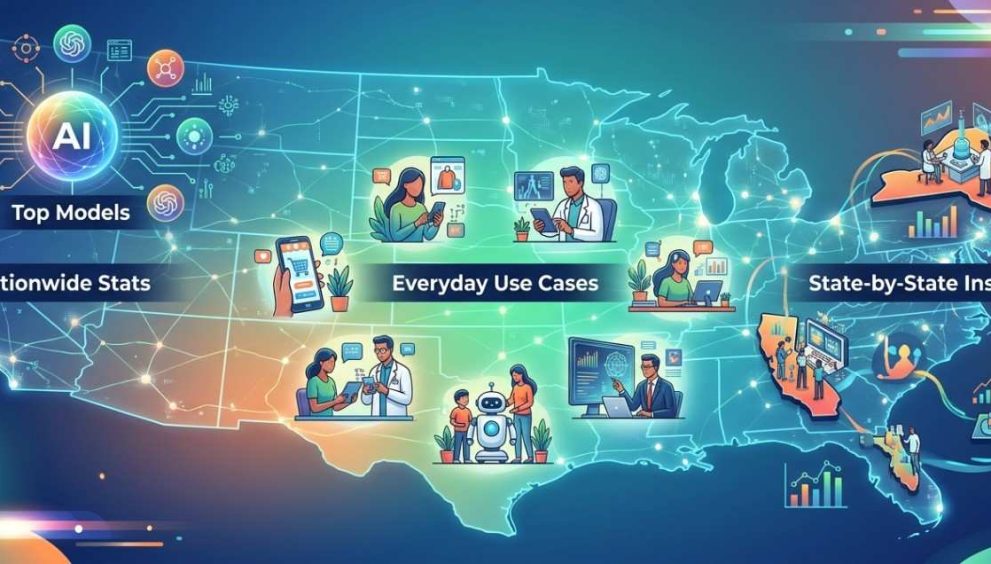
At ClickUSA News, we deliver clear, practical coverage of technology trends that matter to everyday Americans. In 2026, AI adoption continues to surge nationwide, with notable differences emerging from state to state due to tech hubs, industry mix, education levels, and workforce composition. This detailed report covers the latest AI usage statistics, the most popular models, real-world use cases, and a state-by-state overview to help you understand how AI is reshaping life across the country.
How Widespread Is AI Usage Among Americans in 2026?
AI is no longer a Silicon Valley experiment — it’s a daily reality for a large portion of the U.S. population:
- Approximately 55–69% of Americans report using AI tools to some degree, with many surveys showing around 60% of U.S. adults having used AI for information search or other tasks in recent months.
- 19% of U.S. adults (nearly 1 in 5) use AI every single day.
- 31% interact with AI at least several times a day — a sharp rise from previous years.
- Work-related generative AI usage stands at about 41% of the workforce, while non-work/personal usage reaches 48–50% of the population.
- Weekly usage is even higher in some polls, with over 50% of Americans engaging with AI platforms at least once a week.
Adoption has grown rapidly. Generative AI has reached mainstream levels faster than smartphones or personal computers in their early days. Younger Americans lead the way: usage is significantly higher among adults under 30 and millennials, while older generations (especially Baby Boomers) are catching up, particularly for practical tasks like research and shopping.
Business adoption is strong, with roughly 18% of U.S. firms having integrated AI by the end of 2025, and over 20% planning further rollout in 2026. North America leads globally in organizational AI use.
Most Popular AI Models Used by Americans in 2026
Americans have clear preferences when choosing AI tools:
- ChatGPT (OpenAI): Remains the dominant leader with the highest awareness and weekly usage (around 36% of Americans in recent surveys). It’s the go-to for general tasks, writing, and quick assistance.
- Google Gemini: Strong second place (26–37% awareness/usage), especially popular because of deep integration with Google Search, Gmail, Docs, and other everyday tools.
- Microsoft Copilot: Solid third (around 14–35% usage), favored by those working in Microsoft Office and enterprise environments.
- Grok (xAI): Growing quickly, particularly among tech-savvy users and those active on X (Twitter), thanks to its real-time knowledge and straightforward style.
- Claude (Anthropic): Smaller overall share but highly regarded for thoughtful, detailed responses, coding, and professional writing.
Many Americans now use 2–3 different models depending on the task — for example, ChatGPT for speed, Claude for complex analysis, and Gemini for research.
Top AI Use Cases: How Americans Are Actually Using AI
Here’s how people across the country are putting AI to work:
Personal & Everyday Life Use Cases
- Researching topics or answering questions (51%+).
- Writing emails, texts, or documents (28–34%).
- Travel planning, shopping recommendations, and product comparisons.
- Health/wellness ideas, meal planning, and personal advice.
- Creating or editing images and creative projects.
Professional & Work Use Cases
- Content creation, report writing, and email drafting.
- Data analysis, idea generation, and brainstorming.
- Coding, debugging, and technical problem-solving.
- Customer service support and sales outreach.
- Research synthesis and competitive analysis.
Education & Learning
- Helping with schoolwork, essay outlining, and studying (especially popular among teens — 64% of U.S. teens have used AI chatbots).
- Job hunting: resume tailoring and interview preparation.
Americans report saving significant time each week, with many noting improved productivity and creativity. Businesses highlight gains in innovation and efficiency.
State-by-State AI Usage Trends Across America
While national numbers paint a broad picture, AI adoption varies by state due to local economies, tech infrastructure, and demographics:
- Tech-heavy states like California, Washington, New York, and Massachusetts show the highest adoption rates. These areas benefit from proximity to AI companies, high concentrations of knowledge workers, and strong education levels. Urban professionals in San Francisco, Seattle, New York City, and Boston often use multiple AI tools daily for coding, research, and content work.
- Growing Southern and Sun Belt states such as Texas, Florida, Georgia, and North Carolina are seeing rapid growth. booming industries (finance in Texas, tourism/tech in Florida) and large populations drive both personal and business usage. Many mid-sized businesses in these states are adopting AI for customer service and operations.
- Midwestern and Rust Belt states (e.g., Illinois, Ohio, Michigan) show solid but slightly lower adoption, often concentrated in manufacturing, logistics, and agriculture sectors where AI helps with predictive maintenance and optimization.
- Rural and less densely populated states tend to have lower overall usage, but smartphone access is helping close the gap for personal tasks like research and planning. Younger residents in these areas are adopting at rates closer to national averages.
High-income and college-educated households — more common in coastal and urban states — consistently show higher AI engagement. States with strong tech job markets report more work-related usage, while others see heavier personal and educational applications.
These statewide differences highlight how AI is adapting to local needs: advanced automation in tech hubs versus practical productivity tools in heartland communities.
Benefits, Challenges & What’s Next for AI in America
Benefits: Time savings, boosted creativity, accessible tools for small businesses, and potential economic growth. Generative AI is already contributing to measurable productivity gains in sectors with high adoption.
Challenges: Concerns about job impacts, accuracy of outputs, privacy, and ethical issues remain widespread. Many Americans still verify AI results carefully.
Looking ahead, expect deeper integration into daily tools — AI agents for complex tasks, smarter assistants in vehicles and homes, and continued growth in education and healthcare. U.S. innovation leadership keeps America at the forefront of model development and real-world applications.
How Are You Using AI?
AI is transforming how Americans work, learn, and live — with clear differences from state to state. Whether you’re in a bustling tech city or a quiet Midwest town, these tools offer new opportunities for efficiency and creativity.
What’s your favorite AI model and how do you use it? Do you notice differences in AI adoption where you live? Share your experiences in the comments below — from California to Texas, New York to Florida, or anywhere in between. Your stories help paint the full picture of AI across America.
Stay informed with ClickUSA News. Subscribe for the latest on AI trends, technology policy, and stories that affect everyday Americans from coast to coast. Share this article with friends and family who want to understand the AI revolution happening right now.
Keywords: AI usage by Americans 2026, AI adoption statistics US, ChatGPT Gemini Grok Claude usage, AI use cases 2026, state by state AI adoption America, generative AI trends United States