



January 2026 US EV Sales Dip as Incentives Fade

January 2026 US EV Sales Dip as Incentives Fade
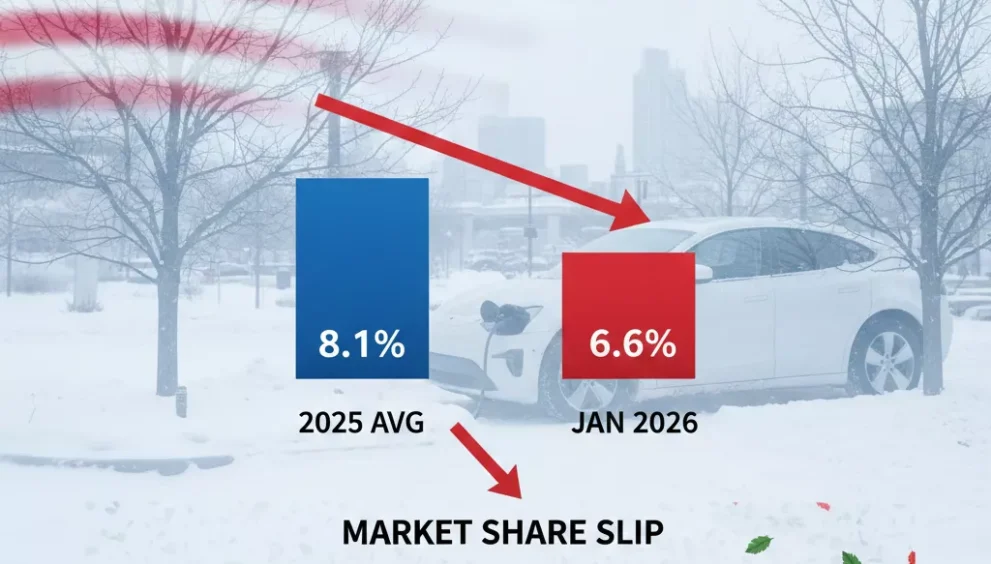
As we kick off February 2026, the latest forecasts for US EV sales January 2026 paint a picture of a market catching its breath after the dramatic shifts of late 2025. Battery-electric vehicles (BEVs) are projected to capture just 6.6% of new retail vehicle sales in January, a notable decline of 2.9 percentage points from January 2025. When combined with plug-in hybrids (PHEVs) at 0.9%, total plug-in electrified vehicles hover below 8%—a sharp contrast to the nearly 12% combined share seen a year earlier.
Having tracked US electrification trends through multiple incentive cycles, subsidy expirations, and policy changes, this January dip aligns with seasonal norms (January is historically the weakest sales month) compounded by structural headwinds: the federal $7,500 EV tax credit phase-out impacting many models from October 2025 onward, reduced manufacturer incentives, rising transaction prices for EVs, and persistent consumer preference for hybrids and ICE vehicles amid economic uncertainty.
Key data comes from authoritative sources like J.D. Power/GlobalData, Cox Automotive, and S&P Global Mobility, which provide early-month projections based on registration trends, dealer reports, and economic indicators. Actual final figures (typically released mid-February) may vary slightly, but the consensus points to a muted start for pure EVs in 2026.
January 2026 US EV Sales Snapshot & Key Statistics
- Projected new-vehicle retail sales: ~908,500 units (down 3.7% YoY per J.D. Power)
- BEV market share: 6.6% (down 2.9 pp YoY)
- PHEV market share: 0.9% (down 1.3 pp YoY)
- Total plug-in (BEV + PHEV): <8% retail share
- Traditional hybrids (HEV): 14.7% (up 1.4 pp YoY)
- ICE-only vehicles: 77.7% (up 2.7 pp YoY)
- Total light-vehicle sales (incl. fleet/non-retail): ~1.12–1.13 million units (SAAR ~15.2–15.3 million)
- EV transaction price impact: Up significantly (e.g., averages ~$51,981 in recent reports), widening the gap vs. gas vehicles (~$45,510)
| Powertrain Type | January 2026 Projected Retail Share | YoY Change (pp) | Notes |
|---|---|---|---|
| BEV | 6.6% | -2.9 | Depressed post-incentive; seasonal winter factors |
| PHEV | 0.9% | -1.3 | Minimal growth; hybrids steal share |
| HEV (non-plug-in) | 14.7% | +1.4 | Strong demand as “bridge” technology |
| ICE-only | 77.7% | +2.7 | Incentives redirected here |
| Total Plug-in | ~7.5% | ~-4.2 | Below 8%; mirrors late-2025 Q4 trends |
These figures reflect early data through late January 2026, with winter weather, economic headwinds, and post-holiday slowdown contributing to the chill.
Why US EV Sales Declined in January 2026
The drop stems from multiple converging factors:
- Federal incentive expiration — Many popular models lost full $7,500 eligibility after Q3 2025, pushing transaction prices higher and shifting buyers toward hybrids or discounted ICE options.
- Manufacturer strategy shift — Automakers redirected discounts to ICE/hybrid lines (average non-EV incentives up ~$403 YoY), while EV discounts narrowed to preserve margins.
- Seasonal & economic pressures — January sales always lag; added high interest rates, inflation concerns, and negative equity on trade-ins (27.3% of deals) hurt big-ticket EV purchases.
- Hybrid surge — Non-plug-in hybrids captured growing interest as a compromise: better efficiency without range anxiety or charging needs.
- Tesla & legacy EV dynamics — Tesla’s share of the EV segment remains dominant but overall volumes soft; GM and others show pockets of strength, but not enough to offset broader softness.
This contrasts sharply with Europe’s recent EV tipping point (BEV surpassing petrol in Dec 2025), highlighting divergent policy and market paths.
Top EV Models & Brand Performance Trends in Early 2026
While full January brand/model breakdowns await official data, early indicators and 2025 momentum suggest:
- Tesla — Likely retained top spot (Model Y, Model 3 leading), but overall EV market softness hits volumes.
- GM — Chevrolet Bolt refresh and Equinox EV ramp-up provide upside; GM held ~13–15% of US EV sales in 2025.
- Ford — Mustang Mach-E and F-150 Lightning remain competitive in trucks/SUVs.
- Hyundai/Kia — Ioniq 5/6, EV6 strong in crossovers.
- Emerging — Rivian, Lucid, and new entrants face headwinds but benefit from fresh product.
Hybrids from Toyota, Honda, and Ford continue stealing share from pure EVs.
Broader 2026 US EV Outlook & Recovery Potential
Cox Automotive forecasts full-year 2026 EV share near 8% (up from 7.8% in 2025), driven by:
- New affordable models (e.g., next-gen Chevrolet Bolt)
- Improved charging infrastructure
- Battery cost reductions
- Potential policy adjustments or state-level incentives
However, risks include ongoing tariff pressures, economic slowdown, and competition from hybrids. S&P Global sees BEV share subdued in H1 2026 before new product lifts.
Implications for Buyers, Dealers & Industry
Consumers: EVs remain pricier upfront (~$760 average monthly payment), but lower fuel/maintenance costs appeal long-term. Leasing (down to 44% of EV deals) becomes key.
Dealers: Retraining for EV service and inventory management critical amid slower turnover.
Industry: Legacy automakers must accelerate affordable platforms and software fixes to compete; hybrids buy time.
For more on EV trends, explore related coverage on electric vehicles and green tech.
What are your thoughts on the US EV slowdown? Share below.
FAQ
- What were US EV sales in January 2026? Projected BEV retail share at 6.6%, with total plug-ins below 8% per J.D. Power forecasts.
- Why did US EV market share drop in January 2026? Loss of federal $7,500 tax credit, higher prices, seasonal slowdown, and hybrid gains.
- What is the projected BEV share for January 2026? 6.6% of new retail sales, down 2.9 pp from January 2025.
- How do PHEVs perform in US January 2026 sales? Only 0.9% share, down 1.3 pp YoY.
- What total new vehicle sales expected January 2026 USA? ~908,500 retail; 1.12–1.13 million overall.
- Which brands lead US EV sales early 2026? Tesla dominant; GM, Ford, Hyundai/Kia strong contenders.
- Is hybrid growth impacting EV sales in 2026? Yes—HEVs at 14.7% share, up 1.4 pp, acting as bridge technology.
- What’s the full-year 2026 US EV forecast? Near 8% share per Cox Automotive, with new models helping recovery.
- How does January 2026 compare to Europe EV trends? US lagging; Europe saw BEV surpass petrol in late 2025.
- Why are EV transaction prices higher in 2026? Reduced incentives and credit losses pushed averages up significantly.
- What role do winter storms play in January EV sales? Potential disruption to showroom traffic and deliveries.
- Are there signs of EV recovery in 2026? Yes—new affordable models and infrastructure improvements expected.
- How do incentives affect US EV adoption? Post-credit expiration, discounts shifted to ICE/hybrids.
- What’s the SAAR for January 2026 US auto sales? ~15.2–15.3 million units.
- Which sources track US EV sales monthly? J.D. Power, Cox Automotive, S&P Global, Kelley Blue Book.
- Is Tesla still leading US EV market in 2026? Yes, but overall segment softness impacts volumes.
- How do tariffs influence January 2026 EV trends? Profit pressure forces pricing balancing act.
- What should buyers consider for EVs now? Leasing options, total ownership costs, and upcoming new models.
Stay updated on the latest auto and EV news—bookmark clicksuanews.com for daily insights!
For more USA news check:
https://clickusanews.com/news/
Latest USA breaking news, national headlines, global affairs, and trending stories.
https://clickusanews.com/sports/
USA sports news, live scores, match highlights, athlete updates, and major sporting events.
https://clickusanews.com/technology/
Technology news covering AI, gadgets, innovation, cybersecurity, and digital trends in the USA.
https://clickusanews.com/entertainment-movies-ott/
Entertainment updates including movies, OTT releases, celebrity news, and pop culture stories.
https://clickusanews.com/business/
Business and finance news with USA market updates, corporate stories, crypto, and economic insights.