



The Complete History of the United States: A Journey Through Time

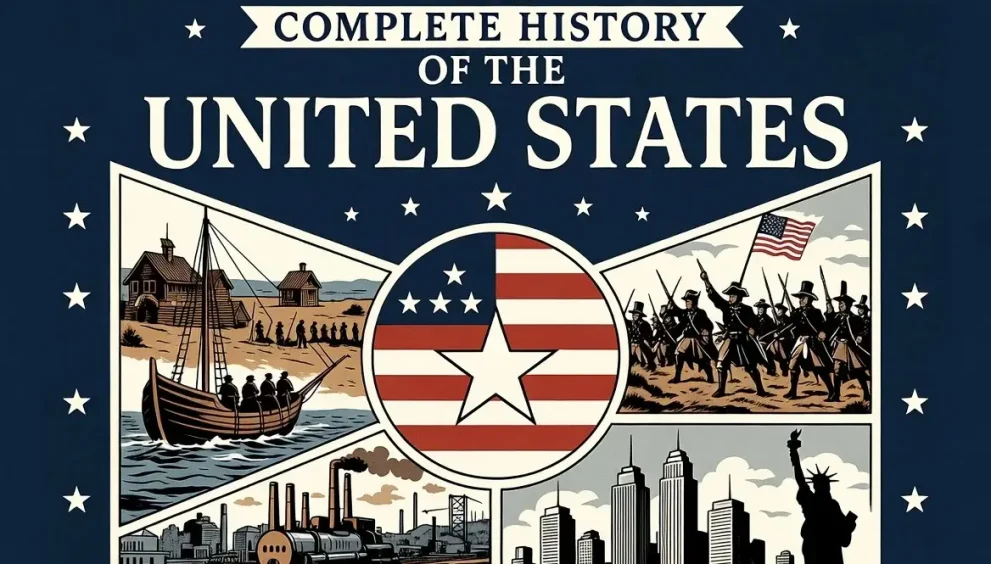
The Complete History of the United States: A Journey Through Time
Introduction
The United States of America stands as one of the world’s most influential nations, with a history spanning over four centuries. From indigenous civilizations to colonial settlements, from revolutionary beginnings to global superpower status, the American story is one of transformation, conflict, innovation, and resilience.
Pre-Colonial America (Before 1492)
Long before European explorers set foot on American soil, the land was home to diverse Native American civilizations. Estimates suggest that between 2 and 18 million indigenous people inhabited North America, organized into hundreds of distinct tribes and nations. These societies developed sophisticated cultures, including the Iroquois Confederacy in the Northeast, the Pueblo peoples in the Southwest, and the Mississippian culture that built impressive earthen mounds.
These indigenous peoples had complex social structures, spiritual traditions, and systems of governance. They cultivated crops like corn, beans, and squash, and maintained intricate trade networks that spanned the continent.
European Exploration and Colonization (1492-1607)
The arrival of Christopher Columbus in 1492 marked the beginning of European contact with the Americas. Though Columbus never reached mainland North America, his voyages opened the door for Spanish, French, Dutch, and English exploration.
Spanish conquistadors established the first permanent European settlement at St. Augustine, Florida, in 1565. Meanwhile, English attempts at colonization initially failed, most notably with the mysterious disappearance of the Roanoke Colony in the 1580s.
The Colonial Period (1607-1765)
Early Settlements
The successful establishment of Jamestown, Virginia, in 1607 marked the beginning of permanent English colonization. The Virginia Company sought profit through tobacco cultivation, which became the colony’s economic foundation. The arrival of the first enslaved Africans in 1619 began the tragic institution of slavery that would scar American history.
In 1620, the Pilgrims landed at Plymouth Rock, seeking religious freedom. Their survival, aided by Native American assistance, became part of American founding mythology. The Massachusetts Bay Colony followed in 1630, establishing a Puritan stronghold.
The Thirteen Colonies
By the mid-1700s, thirteen distinct colonies had emerged along the Atlantic coast:
New England Colonies: Massachusetts, Rhode Island, Connecticut, and New Hampshire developed economies based on fishing, shipbuilding, and trade.
Middle Colonies: New York, New Jersey, Pennsylvania, and Delaware became known as the “breadbasket colonies” due to their agricultural productivity.
Southern Colonies: Maryland, Virginia, North Carolina, South Carolina, and Georgia relied heavily on plantation agriculture and enslaved labor.
Colonial society was diverse, including English, Dutch, German, Scottish, Irish, and African populations, along with diminishing Native American communities displaced by European expansion.
The Road to Revolution (1765-1776)
Tensions between Britain and the American colonies escalated after the French and Indian War (1754-1763). Britain’s attempts to tax the colonies to pay war debts sparked resistance. The Stamp Act of 1765, the Townshend Acts, and the Tea Act led to colonial protests under the rallying cry “No taxation without representation.”
The Boston Massacre in 1770 and the Boston Tea Party in 1773 heightened tensions. Britain’s punitive Intolerable Acts pushed the colonies toward unity. The First Continental Congress convened in 1774 to coordinate resistance.
Violence erupted at Lexington and Concord in April 1775, beginning the Revolutionary War. On July 4, 1776, the Continental Congress adopted the Declaration of Independence, written primarily by Thomas Jefferson, proclaiming the birth of a new nation.
The Revolutionary War (1775-1783)
The American Revolution was a struggle against the world’s most powerful military. Early victories at Saratoga convinced France to ally with the Americans, providing crucial military and financial support. General George Washington’s leadership kept the Continental Army together through harsh winters and numerous setbacks.
The war concluded with the British surrender at Yorktown in 1781. The Treaty of Paris in 1783 formally recognized American independence and established the nation’s borders from the Atlantic to the Mississippi River.
The New Republic (1783-1800)
Creating a Government
The Articles of Confederation, America’s first constitution, proved too weak to govern effectively. In 1787, delegates gathered in Philadelphia to draft a new Constitution. This document established a federal system with three branches of government, incorporating checks and balances.
The Constitution’s ratification sparked intense debate between Federalists, who supported strong central government, and Anti-Federalists, who feared federal overreach. The addition of the Bill of Rights in 1791 guaranteed individual liberties and secured ratification.
Washington’s Presidency
George Washington became the first president in 1789, setting crucial precedents. His administration established the cabinet system, federal judiciary, and national financial institutions. Alexander Hamilton’s economic policies created a national bank and assumed state debts. Washington’s Farewell Address warned against permanent foreign alliances and political factionalism.
Expansion and Division (1800-1860)
Territorial Growth
The Louisiana Purchase of 1803 doubled the nation’s size, acquiring vast territories from France for $15 million. The Lewis and Clark Expedition (1804-1806) explored these new lands, documenting routes to the Pacific.
The concept of Manifest Destiny emerged, promoting the belief that American expansion across the continent was inevitable and divinely ordained. This ideology drove westward migration but resulted in the displacement and decimation of Native American populations.
The War of 1812
Tensions with Britain erupted again in the War of 1812, fought over maritime rights and British support for Native American resistance. Though militarily inconclusive, the war fostered American nationalism and confirmed independence.
The Industrial Revolution
The early 19th century saw rapid industrialization, particularly in the North. Textile mills, railroads, and manufacturing transformed the economy. The cotton gin, invented by Eli Whitney, revolutionized Southern agriculture but also entrenched slavery by making cotton production vastly profitable.
Growing Sectional Tensions
The expansion westward intensified debates over slavery’s extension into new territories. The Missouri Compromise of 1820, the Compromise of 1850, and the Kansas-Nebraska Act of 1854 attempted to maintain balance between free and slave states, but tensions continued mounting.
The abolitionist movement gained strength, with figures like Frederick Douglass, Harriet Tubman, and William Lloyd Garrison advocating for slavery’s end. The Underground Railroad helped thousands of enslaved people escape to freedom.
The Civil War Era (1860-1877)
The Road to War
Abraham Lincoln’s election in 1860 as the first Republican president triggered Southern secession. Seven states initially left the Union, forming the Confederate States of America. The attack on Fort Sumter in April 1861 began the deadliest war in American history.
The War
The Civil War pitted brother against brother, North against South. Major battles at Gettysburg, Antietam, and Shiloh resulted in staggering casualties. Lincoln’s Emancipation Proclamation in 1863 transformed the war into a fight against slavery itself.
The Union’s industrial superiority and larger population ultimately prevailed. General Robert E. Lee surrendered to General Ulysses S. Grant at Appomattox Court House in April 1865, ending the war. Over 600,000 Americans died in the conflict.
Reconstruction
The post-war Reconstruction era attempted to rebuild the South and integrate formerly enslaved people into society. The 13th, 14th, and 15th Amendments abolished slavery, granted citizenship, and protected voting rights.
However, Reconstruction faced fierce resistance. The rise of the Ku Klux Klan and implementation of Jim Crow laws systematically disenfranchised African Americans. The Compromise of 1877 ended Reconstruction, abandoning federal protection of civil rights in the South.
The Gilded Age and Progressive Era (1877-1920)
Industrial Expansion
Post-Civil War America experienced unprecedented industrial growth. Railroads connected the continent, steel production soared, and entrepreneurs like John D. Rockefeller, Andrew Carnegie, and J.P. Morgan built massive corporations. This period created vast wealth alongside extreme poverty and inequality.
Immigration and Urbanization
Millions of immigrants arrived from Europe and Asia, seeking opportunity. Cities grew rapidly, often struggling with overcrowding, poor sanitation, and labor exploitation. Immigration sparked nativist reactions and restrictive legislation like the Chinese Exclusion Act of 1882.
Labor Movements
Workers organized to demand better conditions, leading to violent confrontations like the Haymarket Affair (1886) and the Pullman Strike (1894). Labor unions gradually gained strength, fighting for eight-hour workdays, safer conditions, and fair wages.
Progressive Reforms
The Progressive Era brought significant reforms addressing industrial capitalism’s excesses. Investigative journalists exposed corruption and injustice. Presidents Theodore Roosevelt and Woodrow Wilson implemented antitrust legislation, food safety laws, and conservation measures.
The women’s suffrage movement culminated in the 19th Amendment in 1920, granting women voting rights after decades of activism.
World War I and the Roaring Twenties (1914-1929)
The Great War
America initially remained neutral when World War I erupted in 1914. Submarine warfare and the Zimmermann Telegram eventually drew the nation into war in 1917. American involvement helped tip the balance toward Allied victory in 1918.
President Wilson’s Fourteen Points proposed a framework for lasting peace, including the League of Nations. However, the Senate rejected the Treaty of Versailles, and America never joined the League.
The 1920s
The post-war decade brought prosperity, cultural transformation, and social tension. The Jazz Age celebrated modern culture, with innovations in music, literature, and entertainment. Prohibition attempted to ban alcohol, instead fueling organized crime.
The Harlem Renaissance showcased African American cultural contributions. Yet the decade also saw the revival of the Ku Klux Klan and continued racial violence.
The Great Depression and New Deal (1929-1941)
The stock market crash of October 1929 triggered the worst economic crisis in American history. Banks failed, unemployment reached 25%, and poverty became widespread. Farmers suffered from drought and dust storms that created the Dust Bowl.
Franklin D. Roosevelt’s election in 1932 brought the New Deal, an ambitious program of economic relief, recovery, and reform. Programs like Social Security, the Works Progress Administration, and the Tennessee Valley Authority expanded federal government involvement in the economy and created safety nets still in place today.
World War II (1941-1945)
Entry into War
The Japanese attack on Pearl Harbor on December 7, 1941, brought America into World War II. The nation mobilized completely, with industry converting to war production and millions serving in the military.
The War Effort
American forces fought on multiple fronts, from North Africa to Europe to the Pacific. The D-Day invasion of June 6, 1944, began the liberation of Western Europe from Nazi control. In the Pacific, island-hopping campaigns pushed back Japanese forces.
The Manhattan Project developed atomic weapons. President Harry Truman’s decision to use atomic bombs on Hiroshima and Nagasaki in August 1945 ended the war but sparked ongoing ethical debates.
The Home Front
World War II transformed American society. Women entered the workforce in unprecedented numbers. African Americans and other minorities served with distinction, though in segregated units. The internment of Japanese Americans remains a dark chapter in civil liberties history.
The Cold War Era (1945-1991)
Emerging Superpower
Post-war America emerged as a global superpower alongside the Soviet Union. The Marshall Plan helped rebuild Europe. The Truman Doctrine and containment policy guided American efforts to prevent communism’s spread.
The Korean War (1950-1953), the Cuban Missile Crisis (1962), and the Vietnam War (1955-1975) marked major Cold War conflicts. The Vietnam War particularly divided Americans, sparking massive protests and cultural upheaval.
Domestic Prosperity and Tension
The 1950s brought prosperity and suburban growth. However, this era also featured McCarthyism’s anti-communist hysteria and the beginning of the Civil Rights Movement.
The Civil Rights Movement (1954-1968)
The Supreme Court’s Brown v. Board of Education decision in 1954 declared school segregation unconstitutional, launching the modern civil rights movement. Rosa Parks, Martin Luther King Jr., and countless others fought for equality through nonviolent resistance.
The Civil Rights Act of 1964 and Voting Rights Act of 1965 dismantled legal segregation and protected voting rights. However, King’s assassination in 1968 and ongoing racial tensions demonstrated that legal equality didn’t ensure actual equality.
Social and Political Upheaval (1960s-1970s)
The 1960s brought cultural revolution. The counterculture challenged traditional values, the women’s liberation movement fought for gender equality, and environmental awareness grew. The Watergate scandal forced President Richard Nixon’s resignation in 1974, shaking public trust in government.
Recent Decades (1980-Present)
Conservative Revolution
Ronald Reagan’s presidency (1981-1989) brought conservative policies emphasizing tax cuts, deregulation, and military buildup. The Cold War ended with the Soviet Union’s collapse in 1991, leaving America as the sole superpower.
The Digital Age
The rise of personal computers and the internet revolutionized communication and commerce. The dot-com boom of the 1990s created new wealth, though it ended in a bust.
21st Century Challenges
The September 11, 2001, terrorist attacks transformed American foreign policy, leading to wars in Afghanistan and Iraq. The 2008 financial crisis brought severe economic recession.
The election of Barack Obama as the first African American president in 2008 marked a historic milestone. His administration passed the Affordable Care Act and oversaw economic recovery.
Donald Trump’s presidency (2017-2021) was highly polarizing, marked by immigration restrictions, tax reform, and two impeachments. The COVID-19 pandemic, beginning in 2020, caused massive disruption, killing over one million Americans and reshaping society.
Joe Biden’s election in 2020 and inauguration in January 2021 came amid deep political divisions. Donald Trump won the 2024 presidential election, defeating Kamala Harris, and was inaugurated for a second term on January 20, 2025.
Conclusion
American history reflects constant tension between ideals and reality, between the promise of equality and the persistence of inequality. From indigenous civilizations through colonial settlement, revolutionary birth, civil war, industrial transformation, world wars, civil rights struggles, and into the digital age, the United States has continually evolved.
The American experiment in democracy, though imperfect, has inspired nations worldwide. Understanding this complex history—with its triumphs and tragedies, heroes and villains, progress and setbacks—remains essential for comprehending America’s present and shaping its future. The story continues to unfold, written by each generation of Americans confronting their era’s unique challenges while drawing on the lessons of the past.