


US Energy Shift: AI Demand Sparks Gas Power Surge

US Energy Shift: AI Demand Sparks Gas Power Surge
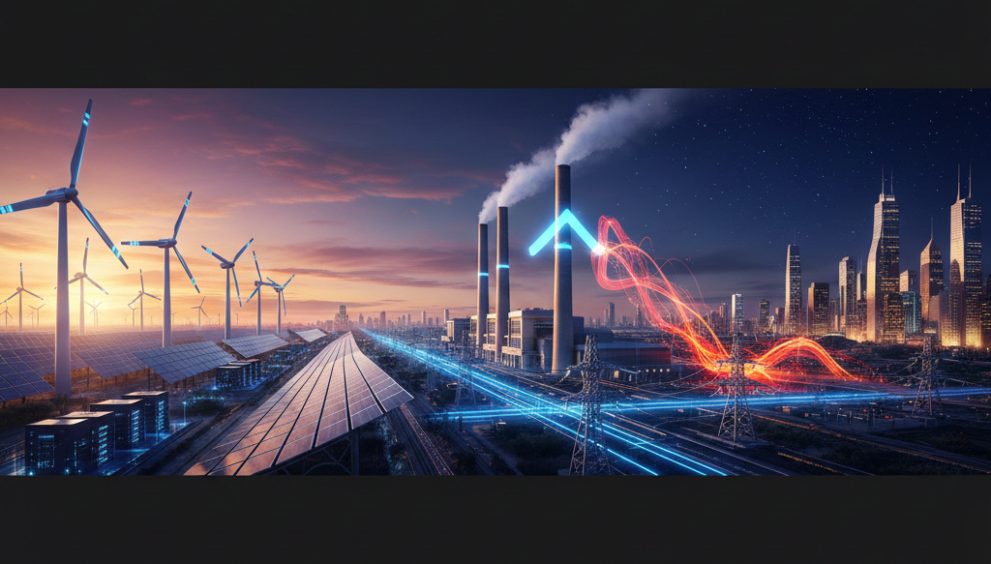
The explosive growth of AI data centers is fueling a dramatic resurgence in US natural gas-fired power generation, pushing the nation toward record levels of new gas plant development in 2026. While this boom supports America’s leadership in artificial intelligence and meets surging electricity needs, it sparks serious climate concerns—locking in decades of carbon emissions, methane leaks, and potential setbacks to clean energy goals.
Recent reports highlight the scale: The US now leads a global surge in gas power additions, with planned and under-construction projects set to shatter historical records. Global Energy Monitor’s (GEM) January 2026 analysis shows the US accounting for nearly a quarter of worldwide gas capacity in development, much of it tied directly to data centers. In 2025 alone, gas-fired power linked to data centers exploded nearly 25-fold compared to prior years, with over 97 gigawatts (GW) in the pipeline explicitly for AI infrastructure.
This shift reverses years of relatively flat electricity demand, driven by hyperscale AI facilities from tech giants like Microsoft, Google, Meta, and Amazon. Data centers, once a niche load, now represent one of the fastest-growing segments of US power consumption.
The AI-Driven Demand Explosion: Numbers Tell the Story
US electricity demand is on track for its strongest multi-year growth since 2000. The US Energy Information Administration (EIA) forecasts record highs in 2025 and 2026, with consumption rising from about 4,198 billion kWh in 2025 to 4,256 billion kWh in 2026 and beyond.
Key drivers include:
- Data center power needs projected to surge from ~62 GW in recent years to over 134 GW by 2030 (S&P Global estimates), or even 106 GW by 2035 (BloombergNEF).
- AI-specific workloads dominating growth, with data centers potentially consuming 6.7% to 12% of total US electricity by 2028 (DOE reports).
- Regional hotspots like Northern Virginia (world’s largest data center cluster), Texas, and parts of the Midwest/PJM grid facing acute strain, where demand spikes 15-25% during peaks.
Natural gas fills the gap because it provides reliable, dispatchable baseload power—unlike intermittent renewables. As of 2024, gas supplied over 40% of electricity to US data centers (IEA data), with projections showing it maintaining the largest share through 2030 despite renewable gains.
Utilities and tech firms increasingly turn to on-site gas plants or “behind-the-meter” generation for speed and reliability. PJM grid rules now fast-track combined data center-gas projects, favoring gas over renewables due to scale and interconnection delays.
Why Natural Gas? Reliability vs. Renewables Lag
AI data centers demand constant, high-density power—often 50-100 MW per facility, equivalent to small cities. They run 24/7, requiring firm capacity that solar and wind can’t always guarantee without massive storage.
- Renewables (wind/solar) grew but face grid constraints, permitting delays, and intermittency.
- Nuclear offers baseload but new builds are slow; some operators revive old plants or extend lives.
- Gas turbines respond quickly, with abundant US supply from shale plays (Marcellus, Permian).
This has led to:
- Revivals of “peaker” plants (even coal in some cases).
- New gas turbine orders surging 27% in 2025.
- Tech capex topping $1 trillion (2024-2026) across major players, much flowing to energy infrastructure.
Deep Dive: Climate and Environmental Impacts
The surge raises alarms about emissions and long-term climate lock-in:
- Carbon Dioxide Emissions — If built, US gas projects in development could emit 12.1 billion tonnes of CO₂ over lifetimes—double current annual US emissions (GEM). Globally, planned gas adds 53.2 billion tonnes.
- Methane Leaks — Natural gas extraction leaks methane (80x more potent than CO₂ over 20 years). US production dominates globally, with oil/gas accounting for a third of methane emissions.
- Health & Pollution — New/revived plants increase local air pollutants (NOx, particulates), harming communities near facilities (often in Texas, Pennsylvania, Virginia).
- Renewable Displacement — Heavy gas reliance could slow decarbonization, with models showing 23% gas generation rise by 2035 and 77% by 2050 under mid-demand scenarios (Union of Concerned Scientists). This risks $1.6 trillion in climate/health damages by 2035, escalating to $4.5 trillion by 2050.
- Grid Strain & Costs — Demand spikes cause outages, price volatility (e.g., PJM winter peaks), and rate hikes. Utilities seek billions in upgrades; households/businesses may foot bills via higher rates.
Critics argue the boom undermines tech climate pledges (e.g., Google’s “moonshots”). Some firms pursue renewables/nuclear, but gas dominates for now.
Broader Implications for 2026 and Beyond
- Economic Winners — Gas producers (e.g., EQT) and midstream benefit from 3-6 Bcf/d added demand by 2030.
- Challenges — Pipeline bottlenecks, supply chain issues, and policy uncertainty (e.g., Trump-era deregulation favoring gas/LNG exports).
- Path Forward — Experts call for:
- Stronger ratepayer protections.
- Accelerated renewables/storage/nuclear.
- Efficiency mandates for AI hardware.
- Policies isolating data center costs.
The US gas power surge powers AI leadership but at a steep climate price. Balancing innovation with sustainability will define 2026’s energy landscape.
Is the AI boom worth the emissions tradeoff—or can clean energy catch up fast enough? Share your thoughts in the comments.
Stay tuned to ClickUSA News for updates on AI, energy, climate, and tech’s real-world impacts.
For more USA news check:
https://clickusanews.com/news/
Latest USA breaking news, national headlines, global affairs, and trending stories.
https://clickusanews.com/sports/
USA sports news, live scores, match highlights, athlete updates, and major sporting events.
https://clickusanews.com/technology/
Technology news covering AI, gadgets, innovation, cybersecurity, and digital trends in the USA.
https://clickusanews.com/entertainment-movies-ott/
Entertainment updates including movies, OTT releases, celebrity news, and pop culture stories.
https://clickusanews.com/business/
Business and finance news with USA market updates, corporate stories, crypto, and economic insights.